May 11, 2026
|
College Wrestling
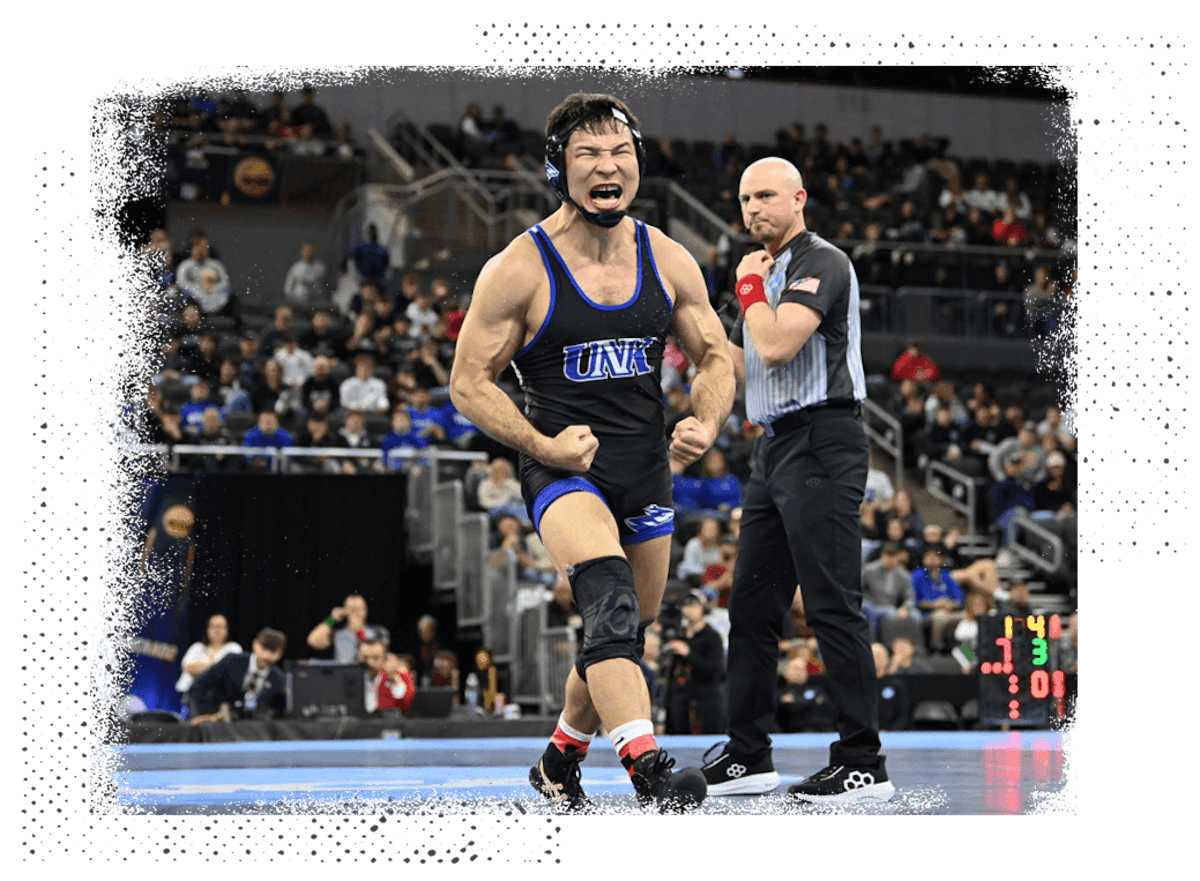
This past March at the 2026 NCAA Division II Wrestling Championships in Sioux Falls, South Dakota, a pair of past junior college (JUCO) wrestlers won national championships in back-to-back weight classes.
Nebraska Kearney's Otgonbayar Batsuuri (174) and McKendree's Darion Johnson (184) claimed NCAA Division II national titles after starting their college careers at junior colleges.
Batsuuri's national title at 174 pounds helped Nebraska Kearney repeat as the NCAA Division II national team champion, while Johnson's run to the national title at 184 pounds helped McKendree finish third in the team standings, which tied the program's highest finish ever.
Nebraska Kearney head wrestling coach Dalton Jensen saw firsthand the impact JUCO wrestlers could make in NCAA Division II wrestling.
Jensen was a member of UNK's national championship team in 2012 that had two major point scorers that came from the junior college level, T.J. Hepburn and Raufeon Stots.
Hepburn and Stots -- along with Jensen -- won individual national titles to help the Lopers win their second national team title in 2012.
Since becoming a college wrestling coach in 2012 (promoted to UNK's head wrestling coach in 2016), Jensen has recruited several junior college wrestlers who have gone on to have successful Division II wrestling careers. Jacobi Deal, a national runner-up in 2025, and Batsuuri, a 2026 national champion, are the most recent examples of junior college wrestlers thriving in his program.
He views junior college wrestlers as more of a known commodity than high school wrestlers.
"Junior college wrestlers have already been exposed to college wrestling," said Jensen. "You see their results. We compete at a lot of the same open tournaments the junior colleges do. A lot of the top junior college wrestling programs come to our open as well. You get a little bit of just an objective taste of how their college-level success has gone so far. That's kind of big when you're recruiting."
Jensen did not have to travel far to discover Batsuuri.
"He won our open the previous two years and had beaten a couple All-Americans and some really good wrestlers that were already proven in Division II," said Jensen. "So he was kind of somebody we knew without a doubt was going to transition to Division II really, really well."
Batsuuri, a Mongolian native who grew up wrestling freestyle, has only been wrestling folkstyle for a few years.
"You just knew his wrestling still had a lot of good upside because of his youth and inexperience in folkstyle," said Jensen. "He still had mat wrestling figure out, which contributed to some of his losses this season. He has continued to develop his skills there and on bottom. We've continued to see him get better and better."
Life University men's head wrestling coach Omi Acosta appreciates JUCO wrestling because of his background. Acosta grew up in the Dominican Republic and moved to Miami, Florida, in high school. He placed in Florida's state tournament and helped South Dade win the 2008 state title. He was a member of the South Dade team that broke Brandon High School's national record winning streak of 459 straight wins. After sustaining an injury as a high school senior, Acosta saw junior college as an opportunity to gain a scholarship at a four-year school. He landed at Waubonsee Community College in Illinois.
"I basically just decided that I wanted to go to junior college because it opened up doors," said Acosta. "I decided to better myself and go JUCO to earn a scholarship to a four-year institution."
After becoming an NJCAA All-American as a freshman, Acosta won a national championship at 133 pounds as a sophomore. He faced wrestlers from all divisions of college wrestling, including Tony Ramos, a three-time All-American and 2014 NCAA champion for the University of Iowa.
"It was my only loss during the regular season," Acosta said of his match against Ramos. "He kicked my butt. But we wrestled everybody … D1, D2, D3, NAIA guys all the time. That's the cool thing about JUCO. We wrestled anybody and it was fun."
He credits his coaches, like John Robinson, for making his junior college experience more transformational than transactional.
"I didn't feel like I had to score team points for them to care about me," said Acosta. "They cared about me since the beginning when they brought me up from Miami and I started living in Illinois."
His college wrestling journey then led him to Grand View University, where he competed in the NAIA for then-head coach Nick Mitchell.
"I was like, if I can't go D1, then I'm going to go where I can get the most scholarship money," said Acosta. "I went to Grand View because they offered a really good package for me."
His on-the-mat success continued at Grand View, where he became a national champion in 2012 and helped lead the program to its first national team title. That eventually led him to coaching. Acosta took over as the head wrestling coach at Life University in 2016. He has built the program into an NAIA wrestling powerhouse.
He has guided the Running Eagles to top-10 finishes every year from 2019 to 2026. Life University won the national team title in 2021 -- halting Grand View's historic nine-year consecutive winning streak -- and has finished runner-up five times, including this past season.
Like Jensen, Acosta has recruited and coached numerous junior college wrestlers. Several have gone on to earn All-America honors and national titles at the NAIA level. One of his most successful wrestlers was Nosomy Pozo, a two-time NJCAA national champion who went on to win two NAIA national titles for Acosta at Life University. In 2025, Thaddeus Long won a national title for Life University two years after winning an NJCAA national title for Carl Albert State. This past season, Life U had multiple past JUCO wrestlers earn All-America honors at the 2026 NAIA Men's Wrestling Championships.

One of the reasons Acosta likes recruiting junior college wrestlers is because many have a chip on their shoulder, something to prove. One of those wrestlers was Asher Eichert.
"He never placed at the high school state tournament," Acosta said of Eichert. "He never placed at the JUCO national tournament. He came here and took second and then won a national title."
Acosta takes pride in the fact he was once a junior college wrestler. It led to him becoming an NAIA national champion wrestler and coach. When recruiting JUCO wrestlers, Acosta shares his experience as a junior college wrestler with potential recruits. He is proof that junior college wrestlers can be the best in whatever division they want to compete in.
"I was a JUCO product and know what it's like to come out of a junior college," said Acosta. "I'm proud to say that I wrestled in junior college," said Acosta.
Terry Pack is a program builder. He built Neosho County Community College into a junior college wrestling power, in the late 90s and early 2000s compiling a dual meet record of 101-17 over six seasons and winning a national championship in 2001.
Pack founded Legends of Gold and built it into one of the biggest and most successful wrestling clubs in the nation.
In 2023, Pack returned to college wrestling coaching when he was hired to lead a new program at Southeast Community College in Nebraska. It didn't take long for Pack to turn Southeast into a national power in NJCAA cwrestling. The SCC men's wrestling program finished 10th at the NJCAA Men's Wrestling Championships in 2024, sixth in 2025 and fourth in 2026. This past season, Southeast finished with five All-Americans, led by two-time national champion Keith Smith (157).
Pack enjoyed coaching at the junior college level because of the development that took place both on and off the mat. Many of the wrestlers he coached at the junior college level were overlooked in high school or struggled with something outside of the wrestling room.
"Most kids who go to junior college are going there because they have academic struggles, financial struggles or social struggles," said Pack. "Those kids take a different kind of structure and watching those kids that others didn't take a chance on succeed was something I really, really enjoyed at that level."
In late February, Pack was tabbed as the first head wrestling coach at Northeastern State, a new NCAA Division II wrestling program in Tahlequah, Oklahoma.
"Once I met with the athletic director, I was sold," said Pack. "He is committed to winning national titles, not just bringing in numbers. I felt like the importance was on winning, having good kids and having kids graduate. I really liked that part."
Now Pack has been tasked with assembling a new roster for a new program that he expects to be competitive immediately. He has leaned on junior college wrestlers as part of his first recruiting class because he believes leadership is important, especially for a new program.
"At four-year schools you have to have some type of leadership," said Pack. "You can't bring in 30 freshmen and expect somebody to be a leader that hasn't been through the trenches and hasn't walked through the fire. We went after some of the best JUCO kids in the country. I think we've got a really good group and a nucleus to do that."
Northeastern State's recruiting class is comprised of both transfers and incoming freshmen. One of the junior college transfers that Northeastern State signed was Keith Smith, a two-time NJCAA national champion for Pack at Southeast Community College.
Pack believes many college coaches shy away from recruiting JUCO wrestlers because of academics.
"A lot of coaches don't want to mess with junior college academics," said Pack. "As a general rule, the academics are not as strong at junior colleges compared to four-year universities. I just think coaches shy away from it because they consider a lot of junior college kids to be knuckleheads and not great students. I think that's a misconception. While there are some programs that you can prove that true, I think there are just as many programs that can call that a falsehood as well."